Trump Administration Nears $500M Spirit Airlines Rescue Package April 22, 2026 by Ryan Mitchell Table of Contents Frequently Asked Questions (FAQs) Breaking: $500M Rescue Package in Advanced Talks What President Trump Said About Spirit Airlines The Fuel Crisis Driving Spirit to the Brink Spirit Airlines Bankruptcy History What Government Aid Could Look Like Spirit’s Equity Stake Offer to Washington Spirit Airlines Stock (SAVE): Investor Outlook What This Means for Spirit Passengers Key Facts at a Glance < Breaking: $500 Million Rescue Package in Advanced Talks The Trump administration is reportedly in advanced negotiations over a $500 million government rescue package for Spirit Airlines, Bloomberg reported on April 22, 2026. The development marks a significant escalation in Washington’s engagement with the struggling ultra-low-cost carrier, which has been circling a potential liquidation for weeks. The Air Current first broke the news of Spirit’s outreach to the White House, describing the airline as seeking “hundreds of millions of dollars in emergency funding.” Sources close to the talks say the structure of any deal remains under active discussion, with both a direct cash infusion and a government equity stake on the table. 🔔 Key Development Bloomberg reported on April 22, 2026 that the Trump administration is nearing a $500 million Spirit rescue package — the single largest proposed direct government intervention for a US airline since the COVID-19 pandemic payroll support programs. What President Trump Said About Spirit Airlines On April 21, 2026, President Trump addressed Spirit Airlines’ crisis directly in an interview on CNBC’s Squawk Box, making unusually personal comments about a single carrier’s survival. “Spirit’s in trouble, and I’d love somebody to buy Spirit. It’s 14,000 jobs. And maybe the federal government should help that one out.”— President Donald Trump, CNBC Squawk Box, April 21, 2026 Trump also expressed a preference for a private-sector acquisition, saying he would “love somebody to buy Spirit.” At the same time, he voiced opposition to a potential merger between American Airlines and United Airlines, emphasizing he wants competition preserved in the industry. Transportation Secretary Sean Duffy reinforced the White House’s posture when asked by reporters, confirming that the president had directed his department to review possible relief options. “He’s directed us to take a look. I’ll have a conversation with the president later today,” Duffy said, adding that he was scheduled to meet with executives from several budget carriers that same afternoon. The Fuel Crisis Driving Spirit to the Brink The proximate cause of Spirit’s current crisis is a dramatic spike in jet fuel prices that blindsided the airline’s already fragile restructuring plan. When the US and Israel launched strikes on Iran in late February 2026, oil markets reacted sharply — pushing crude above $100 per barrel and sending jet fuel costs soaring. According to Argus data published by Airlines for America, average jet fuel prices in major US markets including Los Angeles, Chicago, Houston, and New York reached $3.87 per gallon in mid-April 2026 — up from roughly $2.50 per gallon before the Iran conflict began. In some markets, jet fuel costs have nearly doubled. The Numbers Are Devastating for Spirit Analysts estimate the fuel surge adds approximately $360 million in annual costs to Spirit’s operations. That figure is particularly punishing because it exceeds the airline’s total unrestricted cash reserves, turning the carrier cash-flow negative almost overnight. Fuel is the airline industry’s largest expense after labor, and ultra-low-cost carriers like Spirit have almost no pricing buffer to absorb cost shocks of this magnitude. The cost surge directly undermined the creditor agreement Spirit reached in late February 2026 — a deal that was premised on a much more favorable fuel pricing environment. Within weeks of signing that agreement, the financial assumptions underpinning it had become untenable. “Spirit is flying on financial fumes. I would tell Spirit flyers to start looking for backup reservations just to be on the safe side.”— Henry Harteveldt, Aviation Industry Analyst, CBS News Spirit Airlines Bankruptcy History: A Timeline Spirit’s financial collapse has unfolded in stages, beginning well before the 2026 fuel crisis. The airline’s troubles trace back to post-pandemic shifts in consumer behavior and a critical regulatory setback. 2020–2024Spirit Airlines accumulates losses exceeding $2.5 billion as pandemic-era demand evaporates and consumers increasingly prefer full-service travel experiences over bare-bones budget flying. January 2024A federal judge blocks JetBlue’s proposed acquisition of Spirit on antitrust grounds, stripping the carrier of its most viable exit strategy and leaving it to navigate an increasingly hostile market alone. November 2024Spirit Airlines files for Chapter 11 bankruptcy protection for the first time, securing a restructuring support agreement backed by bondholders including a $350 million equity investment and $300 million in debtor-in-possession financing. March 2025Spirit emerges from its first bankruptcy with $795 million in debt eliminated through equitization and plans to rebuild around a smaller, refocused network. August 2025Spirit files for Chapter 11 bankruptcy a second time within a year, seeking further restructuring after continued operational losses and an inability to compete effectively against larger carriers’ expanded budget offerings. February 2026Spirit reaches a new creditor agreement and files court papers to auction 20 Airbus A320/A321 aircraft. The plan: shrink to an 80-plane fleet and exit bankruptcy by summer 2026. Jet fuel is then priced near $2.50 per gallon. Late February 2026US and Israeli strikes on Iran send oil markets into turmoil. Jet fuel prices begin a dramatic surge that will nearly double costs by mid-April. April 15, 2026Bloomberg and the Wall Street Journal report that Spirit’s liquidation could happen “as early as this week” as creditors weigh their options amid cash shortfalls. April 17, 2026CBS News and The Air Current report Spirit has formally approached the Trump administration for emergency financial assistance, requesting hundreds of millions of dollars. April 20, 2026Bloomberg reports Spirit has floated offering the US government an equity stake in the airline in exchange for an emergency cash infusion. April 21, 2026President Trump publicly signals support for federal assistance in a CNBC interview. Transportation Secretary Sean Duffy confirms the administration is reviewing options. April 22, 2026Bloomberg reports the Trump administration is nearing a $500 million Spirit rescue package. CNBC confirms advanced talks are underway. What Government Aid for Spirit Airlines Could Look Like The US government has a precedent for airline bailouts, though those programs were typically broad-based rather than targeted at a single carrier. After the September 11, 2001 attacks, the Air Transportation Safety and System Stabilization Act disbursed approximately $4.6 billion to more than 400 air carriers. During the COVID-19 pandemic, airlines received billions in payroll support grants and loans spread across the industry. A single-carrier bailout for Spirit would be a different animal — and legally complex. Aviation analysts have noted that the Department of Transportation does not have straightforward statutory authority to hand out large subsidies to one airline. The Treasury Department’s Exchange Stabilization Fund has never been used for a purpose of this kind. Analysts at the View from the Wing noted the administration might choose to act, assert the legal authority is “murky enough,” and effectively dare opponents to challenge it in court — by which time Spirit would either have stabilized or failed. Possible Aid Mechanisms Several structures have been discussed or speculated upon in financial media. A direct government loan or loan guarantee would give Spirit liquidity without an immediate equity stake. A government equity purchase would mirror the Intel deal and give taxpayers an ownership position. War risk insurance — something DOT can provide when private coverage is unavailable — could address a narrow slice of Spirit’s exposure. Finally, a facilitated acquisition deal, where the government encourages or incentivizes a buyer such as Frontier or Allegiant, remains a possibility given Trump’s stated preference for a private-sector solution. ⚠️ Industry Context The Association of Value Airlines, representing Spirit, Frontier, and other budget carriers, has separately lobbied Congress to suspend the 7.5% federal excise tax on airline tickets — a measure that would provide industry-wide relief rather than singling out Spirit for special treatment. Spirit’s Equity Stake Offer to Washington Among the most striking elements of Spirit’s rescue pitch is its offer to give the US government a direct ownership stake in the airline. Bloomberg first reported the proposal on April 20, 2026, describing it as an offer floated during confidential discussions with administration officials. The model being referenced is the White House’s 2025 investment in Intel Corporation, in which the government took a meaningful equity position as part of a deal to shore up domestic semiconductor manufacturing. Spirit’s pitch essentially reframes the bailout as a government investment rather than a subsidy — a framing that could make it more politically palatable in Washington. However, critics point to a fundamental tension: the core value proposition of an ultra-low-cost carrier is its low operating costs, which in theory translate to low fares for consumers. If taxpayer subsidies are propping up the airline, that argument becomes harder to sustain. Government ownership could also raise competition questions if Spirit continues operating in markets alongside unsubsidized rivals. Spirit Airlines Stock (SAVE): Investor Outlook Spirit Airlines stock has been through an extraordinary journey over the past two years. NYSE-listed as SAVE before its first bankruptcy in November 2024, the shares were delisted as part of that restructuring and shifted to over-the-counter trading. At the time, analysts noted that existing common stockholders faced complete equity cancellation — and the OTC shares were expected to trade for pennies on the dollar, reflecting the speculative premium attached to alternative rescue scenarios. The Speculative Nature of SAVE Today Any investor currently holding or considering Spirit Aviation Holdings equity should understand the speculative nature of that position. In bankruptcy, equity holders are last in the priority waterfall — behind secured creditors, unsecured creditors, and bondholders. A government equity injection, if structured as new preferred equity, could further dilute or eliminate existing shareholder value depending on how the deal is structured. The $500 million rescue figure, if confirmed, would primarily be intended to keep Spirit operating and meeting its obligations to creditors — not to create value for pre-existing equity holders. That said, any credible rescue news typically sparks a short-term speculative rally in bankrupt airline stocks, as traders bet on outcomes that break favorably from the liquidation scenario. Investors considering Spirit Airlines stock should consult a licensed financial advisor. This article does not constitute investment advice. 📊 Important Note for Investors Spirit Airlines common shares were cancelled during its first bankruptcy restructuring in early 2025. Any securities currently trading under Spirit-related tickers are highly speculative instruments. The value of a government rescue to common stockholders depends entirely on deal terms that have not been publicly disclosed. What This Means for Spirit Passengers For the approximately 14,000 Spirit employees and the millions of passengers who rely on the carrier — particularly in South Florida, where Spirit operates out of its primary hub at Fort Lauderdale-Hollywood International Airport — the outcome of rescue talks has deeply practical implications. Spirit has already been trimming its route network throughout early 2026, cutting service to destinations including Grand Cayman, Managua, San Salvador, Charleston, Cleveland, Kansas City, Key West, and Las Vegas from Fort Lauderdale. Despite these cuts, Spirit remains the carrier with the highest passenger exposure at FLL. If the airline were to cease operations — either through an abrupt halt following creditor action or a more orderly wind-down — travelers with future bookings would face significant disruption. In a rapid shutdown scenario, there is no guarantee of refunds processed quickly, and travelers could be left scrambling for alternative flights at last-minute prices. Travel insurance that covers airline default is a prudent consideration for those with Spirit bookings in the coming weeks. Analysts expect JetBlue, Frontier, and Allegiant to be the primary beneficiaries of any Spirit capacity exit in key markets, likely absorbing routes and potentially hiring displaced Spirit personnel. Key Facts at a Glance Topic Detail Stock Ticker SAVE (OTC, post-bankruptcy delisting) Airline Type Ultra-low-cost carrier (ULCC) Headquarters Dania Beach (Fort Lauderdale), Florida Employees ~14,000 Bankruptcy Filings 2 — Nov. 2024 & Aug. 2025 Current Status In Chapter 11, rescue talks underway Rescue Package Reported ~$500 million (Bloomberg, April 22, 2026) Primary Cause of Current Crisis Jet fuel price surge post-Iran strikes Fuel Cost Increase ~$360M additional annual cost Jet Fuel Price (April 2026) ~$3.87/gallon (vs. ~$2.50 pre-crisis) Fleet Size Target 80 aircraft (down from pre-bankruptcy peak) Government Aid Structure Discussed Equity stake + cash infusion Losses Since 2020 More than $2.5 billion Failed Merger JetBlue acquisition blocked, Jan. 2024 Disclaimer: This article is for informational purposes only and does not constitute financial, investment, or legal advice. Spirit Airlines stock (SAVE) involves significant risk, including potential total loss of capital. Always consult a licensed financial advisor before making investment decisions. Information is based on reports available as of April 22, 2026, and may change rapidly given the fluid nature of ongoing negotiations.
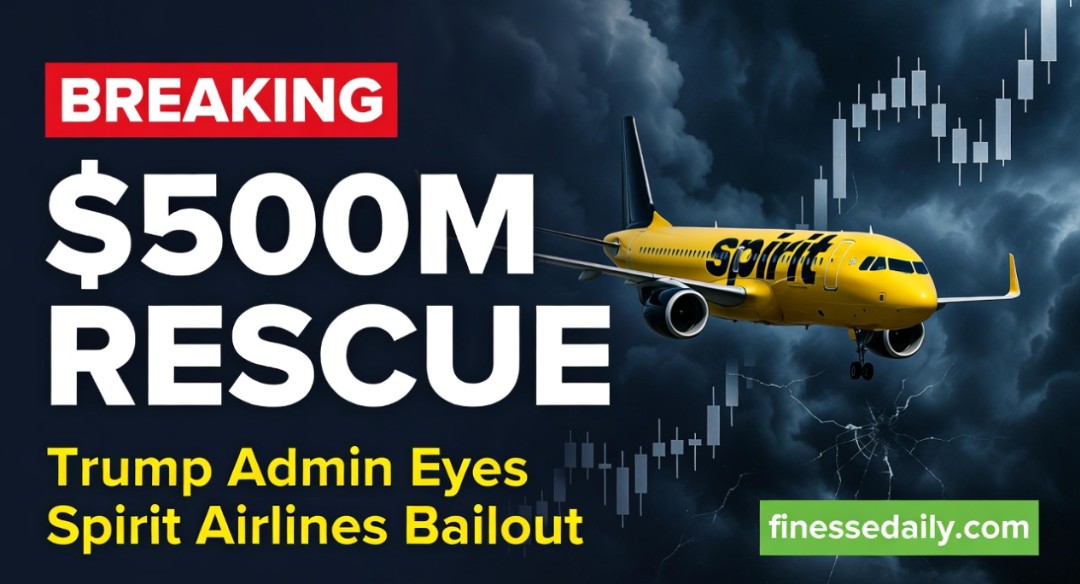
Breaking: $500 Million Rescue Package in Advanced Talks The Trump administration is reportedly in advanced negotiations over a $500 million government rescue package for Spirit Airlines, Bloomberg reported on April 22, 2026. The development marks a significant escalation in Washington’s engagement with the struggling ultra-low-cost carrier, which has been circling a potential liquidation for weeks. The Air Current first broke the news of Spirit’s outreach to the White House, describing the airline as seeking “hundreds of millions of dollars in emergency funding.” Sources close to the talks say the structure of any deal remains under active discussion, with both a direct cash infusion and a government equity stake on the table. 🔔 Key Development Bloomberg reported on April 22, 2026 that the Trump administration is nearing a $500 million Spirit rescue package — the single largest proposed direct government intervention for a US airline since the COVID-19 pandemic payroll support programs.
What President Trump Said About Spirit Airlines On April 21, 2026, President Trump addressed Spirit Airlines’ crisis directly in an interview on CNBC’s Squawk Box, making unusually personal comments about a single carrier’s survival. “Spirit’s in trouble, and I’d love somebody to buy Spirit. It’s 14,000 jobs. And maybe the federal government should help that one out.”— President Donald Trump, CNBC Squawk Box, April 21, 2026 Trump also expressed a preference for a private-sector acquisition, saying he would “love somebody to buy Spirit.” At the same time, he voiced opposition to a potential merger between American Airlines and United Airlines, emphasizing he wants competition preserved in the industry. Transportation Secretary Sean Duffy reinforced the White House’s posture when asked by reporters, confirming that the president had directed his department to review possible relief options. “He’s directed us to take a look. I’ll have a conversation with the president later today,” Duffy said, adding that he was scheduled to meet with executives from several budget carriers that same afternoon.
The Fuel Crisis Driving Spirit to the Brink The proximate cause of Spirit’s current crisis is a dramatic spike in jet fuel prices that blindsided the airline’s already fragile restructuring plan. When the US and Israel launched strikes on Iran in late February 2026, oil markets reacted sharply — pushing crude above $100 per barrel and sending jet fuel costs soaring. According to Argus data published by Airlines for America, average jet fuel prices in major US markets including Los Angeles, Chicago, Houston, and New York reached $3.87 per gallon in mid-April 2026 — up from roughly $2.50 per gallon before the Iran conflict began. In some markets, jet fuel costs have nearly doubled. The Numbers Are Devastating for Spirit Analysts estimate the fuel surge adds approximately $360 million in annual costs to Spirit’s operations. That figure is particularly punishing because it exceeds the airline’s total unrestricted cash reserves, turning the carrier cash-flow negative almost overnight. Fuel is the airline industry’s largest expense after labor, and ultra-low-cost carriers like Spirit have almost no pricing buffer to absorb cost shocks of this magnitude. The cost surge directly undermined the creditor agreement Spirit reached in late February 2026 — a deal that was premised on a much more favorable fuel pricing environment. Within weeks of signing that agreement, the financial assumptions underpinning it had become untenable. “Spirit is flying on financial fumes. I would tell Spirit flyers to start looking for backup reservations just to be on the safe side.”— Henry Harteveldt, Aviation Industry Analyst, CBS News
Spirit Airlines Bankruptcy History: A Timeline Spirit’s financial collapse has unfolded in stages, beginning well before the 2026 fuel crisis. The airline’s troubles trace back to post-pandemic shifts in consumer behavior and a critical regulatory setback. 2020–2024Spirit Airlines accumulates losses exceeding $2.5 billion as pandemic-era demand evaporates and consumers increasingly prefer full-service travel experiences over bare-bones budget flying. January 2024A federal judge blocks JetBlue’s proposed acquisition of Spirit on antitrust grounds, stripping the carrier of its most viable exit strategy and leaving it to navigate an increasingly hostile market alone. November 2024Spirit Airlines files for Chapter 11 bankruptcy protection for the first time, securing a restructuring support agreement backed by bondholders including a $350 million equity investment and $300 million in debtor-in-possession financing. March 2025Spirit emerges from its first bankruptcy with $795 million in debt eliminated through equitization and plans to rebuild around a smaller, refocused network. August 2025Spirit files for Chapter 11 bankruptcy a second time within a year, seeking further restructuring after continued operational losses and an inability to compete effectively against larger carriers’ expanded budget offerings. February 2026Spirit reaches a new creditor agreement and files court papers to auction 20 Airbus A320/A321 aircraft. The plan: shrink to an 80-plane fleet and exit bankruptcy by summer 2026. Jet fuel is then priced near $2.50 per gallon. Late February 2026US and Israeli strikes on Iran send oil markets into turmoil. Jet fuel prices begin a dramatic surge that will nearly double costs by mid-April. April 15, 2026Bloomberg and the Wall Street Journal report that Spirit’s liquidation could happen “as early as this week” as creditors weigh their options amid cash shortfalls. April 17, 2026CBS News and The Air Current report Spirit has formally approached the Trump administration for emergency financial assistance, requesting hundreds of millions of dollars. April 20, 2026Bloomberg reports Spirit has floated offering the US government an equity stake in the airline in exchange for an emergency cash infusion. April 21, 2026President Trump publicly signals support for federal assistance in a CNBC interview. Transportation Secretary Sean Duffy confirms the administration is reviewing options. April 22, 2026Bloomberg reports the Trump administration is nearing a $500 million Spirit rescue package. CNBC confirms advanced talks are underway.
What Government Aid for Spirit Airlines Could Look Like The US government has a precedent for airline bailouts, though those programs were typically broad-based rather than targeted at a single carrier. After the September 11, 2001 attacks, the Air Transportation Safety and System Stabilization Act disbursed approximately $4.6 billion to more than 400 air carriers. During the COVID-19 pandemic, airlines received billions in payroll support grants and loans spread across the industry. A single-carrier bailout for Spirit would be a different animal — and legally complex. Aviation analysts have noted that the Department of Transportation does not have straightforward statutory authority to hand out large subsidies to one airline. The Treasury Department’s Exchange Stabilization Fund has never been used for a purpose of this kind. Analysts at the View from the Wing noted the administration might choose to act, assert the legal authority is “murky enough,” and effectively dare opponents to challenge it in court — by which time Spirit would either have stabilized or failed. Possible Aid Mechanisms Several structures have been discussed or speculated upon in financial media. A direct government loan or loan guarantee would give Spirit liquidity without an immediate equity stake. A government equity purchase would mirror the Intel deal and give taxpayers an ownership position. War risk insurance — something DOT can provide when private coverage is unavailable — could address a narrow slice of Spirit’s exposure. Finally, a facilitated acquisition deal, where the government encourages or incentivizes a buyer such as Frontier or Allegiant, remains a possibility given Trump’s stated preference for a private-sector solution. ⚠️ Industry Context The Association of Value Airlines, representing Spirit, Frontier, and other budget carriers, has separately lobbied Congress to suspend the 7.5% federal excise tax on airline tickets — a measure that would provide industry-wide relief rather than singling out Spirit for special treatment.
Spirit’s Equity Stake Offer to Washington Among the most striking elements of Spirit’s rescue pitch is its offer to give the US government a direct ownership stake in the airline. Bloomberg first reported the proposal on April 20, 2026, describing it as an offer floated during confidential discussions with administration officials. The model being referenced is the White House’s 2025 investment in Intel Corporation, in which the government took a meaningful equity position as part of a deal to shore up domestic semiconductor manufacturing. Spirit’s pitch essentially reframes the bailout as a government investment rather than a subsidy — a framing that could make it more politically palatable in Washington. However, critics point to a fundamental tension: the core value proposition of an ultra-low-cost carrier is its low operating costs, which in theory translate to low fares for consumers. If taxpayer subsidies are propping up the airline, that argument becomes harder to sustain. Government ownership could also raise competition questions if Spirit continues operating in markets alongside unsubsidized rivals.
Spirit Airlines Stock (SAVE): Investor Outlook Spirit Airlines stock has been through an extraordinary journey over the past two years. NYSE-listed as SAVE before its first bankruptcy in November 2024, the shares were delisted as part of that restructuring and shifted to over-the-counter trading. At the time, analysts noted that existing common stockholders faced complete equity cancellation — and the OTC shares were expected to trade for pennies on the dollar, reflecting the speculative premium attached to alternative rescue scenarios. The Speculative Nature of SAVE Today Any investor currently holding or considering Spirit Aviation Holdings equity should understand the speculative nature of that position. In bankruptcy, equity holders are last in the priority waterfall — behind secured creditors, unsecured creditors, and bondholders. A government equity injection, if structured as new preferred equity, could further dilute or eliminate existing shareholder value depending on how the deal is structured. The $500 million rescue figure, if confirmed, would primarily be intended to keep Spirit operating and meeting its obligations to creditors — not to create value for pre-existing equity holders. That said, any credible rescue news typically sparks a short-term speculative rally in bankrupt airline stocks, as traders bet on outcomes that break favorably from the liquidation scenario. Investors considering Spirit Airlines stock should consult a licensed financial advisor. This article does not constitute investment advice. 📊 Important Note for Investors Spirit Airlines common shares were cancelled during its first bankruptcy restructuring in early 2025. Any securities currently trading under Spirit-related tickers are highly speculative instruments. The value of a government rescue to common stockholders depends entirely on deal terms that have not been publicly disclosed.
What This Means for Spirit Passengers For the approximately 14,000 Spirit employees and the millions of passengers who rely on the carrier — particularly in South Florida, where Spirit operates out of its primary hub at Fort Lauderdale-Hollywood International Airport — the outcome of rescue talks has deeply practical implications. Spirit has already been trimming its route network throughout early 2026, cutting service to destinations including Grand Cayman, Managua, San Salvador, Charleston, Cleveland, Kansas City, Key West, and Las Vegas from Fort Lauderdale. Despite these cuts, Spirit remains the carrier with the highest passenger exposure at FLL. If the airline were to cease operations — either through an abrupt halt following creditor action or a more orderly wind-down — travelers with future bookings would face significant disruption. In a rapid shutdown scenario, there is no guarantee of refunds processed quickly, and travelers could be left scrambling for alternative flights at last-minute prices. Travel insurance that covers airline default is a prudent consideration for those with Spirit bookings in the coming weeks. Analysts expect JetBlue, Frontier, and Allegiant to be the primary beneficiaries of any Spirit capacity exit in key markets, likely absorbing routes and potentially hiring displaced Spirit personnel.
Key Facts at a Glance Topic Detail Stock Ticker SAVE (OTC, post-bankruptcy delisting) Airline Type Ultra-low-cost carrier (ULCC) Headquarters Dania Beach (Fort Lauderdale), Florida Employees ~14,000 Bankruptcy Filings 2 — Nov. 2024 & Aug. 2025 Current Status In Chapter 11, rescue talks underway Rescue Package Reported ~$500 million (Bloomberg, April 22, 2026) Primary Cause of Current Crisis Jet fuel price surge post-Iran strikes Fuel Cost Increase ~$360M additional annual cost Jet Fuel Price (April 2026) ~$3.87/gallon (vs. ~$2.50 pre-crisis) Fleet Size Target 80 aircraft (down from pre-bankruptcy peak) Government Aid Structure Discussed Equity stake + cash infusion Losses Since 2020 More than $2.5 billion Failed Merger JetBlue acquisition blocked, Jan. 2024