
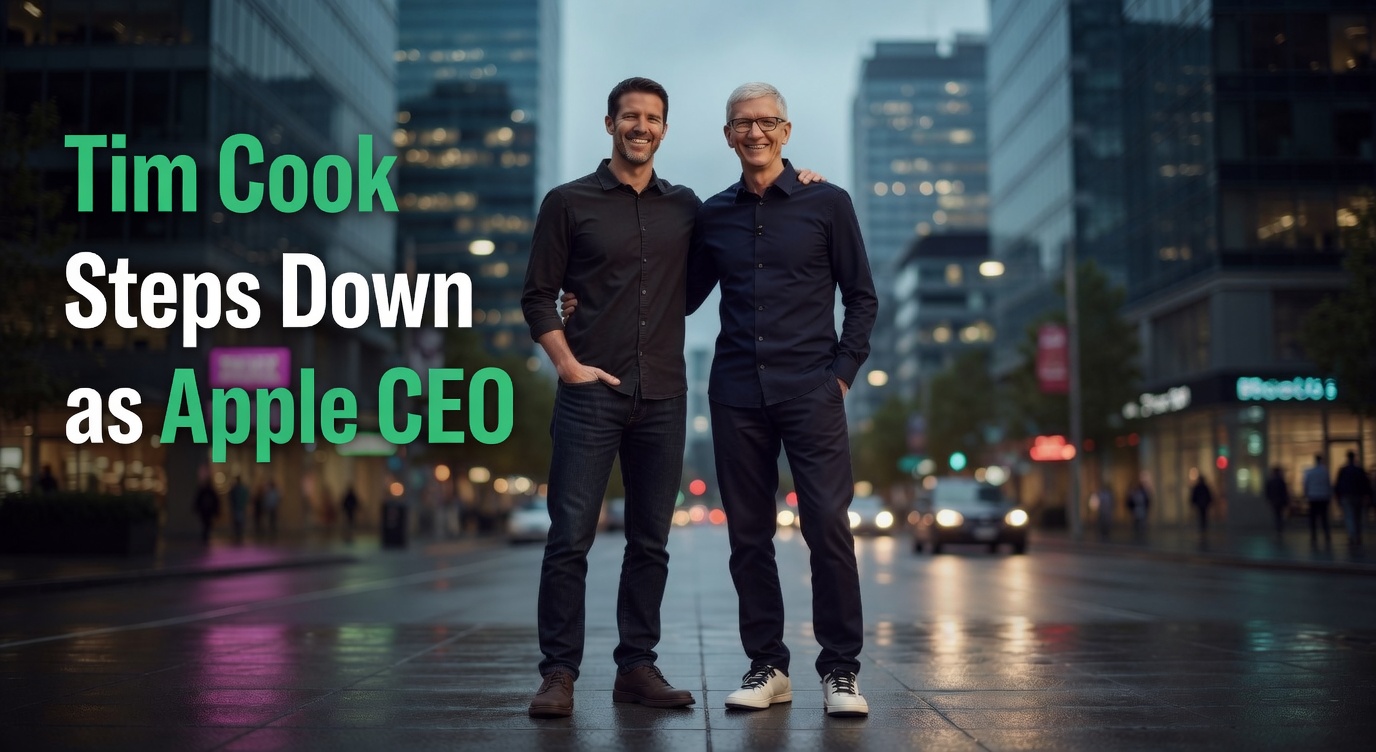
After 15 years of transforming Apple from a $350 billion company into the world’s most valuable corporation, Tim Cook is handing the keys to a 25-year Apple veteran and engineer. Here’s what it means for your money.
Apple Just Dropped Its Biggest Bombshell Since Steve Jobs Died
You probably didn’t see this coming today. Neither did Wall Street. On Monday, April 20, 2026, Apple Inc. sent shockwaves through Silicon Valley and global financial markets with a single press release: Tim Cook, 65, is stepping down as Apple CEO effective September 1, 2026. In his place steps John Ternus — Apple’s soft-spoken, engineering-obsessed hardware chief who has spent the last 25 years quietly building some of the most successful products in consumer electronics history.
This is not a crisis. There’s no scandal. There’s no boardroom revolt. Apple called it the result of “a thoughtful, long-term succession planning process,” and the transition was unanimously approved by the board of directors. But make no mistake — this is the most consequential executive handoff in the tech industry since Cook himself stepped into Steve Jobs’ shoes in 2011, weeks before Jobs passed away from pancreatic cancer.
Cook will remain at Apple, transitioning to the role of Executive Chairman of the Board of Directors. He’ll continue to be involved — particularly engaging with global policymakers — but the day-to-day running of the world’s most valuable company will belong to Ternus.
It has been the greatest privilege of my life to be the CEO of Apple and to have been trusted to lead such an extraordinary company.
— Tim Cook, Apple CEO
02 — The Numbers
Tim Cook’s Legacy in Cold, Hard Dollars: How He Turned Apple Into the Most Valuable Company on Earth
Numbers don’t lie. When Tim Cook formally became Apple’s CEO on August 24, 2011, Apple’s market capitalization sat at roughly $350 billion. That’s not nothing — but it was a long way from what Cook would build. On the day he announced his departure, Apple’s market cap touched $4 trillion, making it the most valuable publicly traded company on the planet.
Revenue nearly quadrupled under his leadership, climbing from around $108 billion in fiscal year 2011 to over $416 billion in the most recent fiscal year. Net income expanded from roughly $25 billion to $112 billion. Cook didn’t just run Apple — he systematically multiplied it.
He did it with an operations obsession that Jobs himself respected. When Cook arrived in Cupertino in 1998 as SVP of Worldwide Operations, Apple was hemorrhaging cash. Cook closed warehouses, consolidated suppliers, and transformed Apple’s supply chain from a liability into one of the most formidable competitive moats in global business. That same discipline carried through his entire tenure as CEO.
Apple’s Growth Under Tim Cook at a Glance
- Market Cap: $350B (2011) → $4T+ (2026) — a 24x increase
- Annual Revenue: ~$108B → $416B
- Net Income: ~$25B → $112B
- Services Revenue: Near-zero → $100B+ annually
- Tim Cook’s Net Worth: Estimated ~$3 billion (Forbes, 2026)
- Cook’s 2025 Total Compensation: $74.6M (incl. $3M base salary + stock awards)
- Tim Cook’s Age: 65 (born November 1, 1960, Mobile, Alabama)
Beyond the headline numbers, Cook oversaw the launch of several category-defining products: the Apple Watch, AirPods, Apple Pay, Apple TV+, and the Apple Silicon Mac transition. He also took Apple deeper into services — a strategic pivot that now generates over $100 billion a year and represents the company’s most profitable segment per unit of revenue.
03 — The New CEO
Who Is John Ternus? Meet the Engineer Who’s Now in Charge of a $4 Trillion Machine
If you haven’t heard of John Ternus before today, that’s partly by design. Apple’s culture runs on institutional privacy, and its executives — especially at the engineering level — rarely seek the spotlight. But inside Cupertino, Ternus is regarded as one of the most capable leaders the company has ever produced.
Ternus, 50, was born in May 1975 and earned a Bachelor of Science in Mechanical Engineering from the University of Pennsylvania in 1997 — where he also competed as a varsity swimmer. Before Apple, he spent four years at Virtual Research Systems designing early virtual reality headsets. In 2001, he joined Apple’s product design team, starting on the Apple Cinema Display. He would go on to never leave.
| Field | Details |
|---|---|
| Full Name | John Patrick Ternus |
| Age | 50–51 (born May 1975) |
| Education | B.S. Mechanical Engineering, University of Pennsylvania (1997) |
| Joined Apple | 2001 |
| Previous Role | SVP, Hardware Engineering (since 2021) |
| CEO Effective | September 1, 2026 |
| Net Worth (est.) | $150M–$200M+ (career equity) |
| Personal Life | Details kept private; not publicly disclosed |
His rise through Apple was methodical and meritocratic. By 2013 he was VP of Hardware Engineering, overseeing Mac, iPad, and AirPods. In 2020 he took charge of iPhone hardware engineering — the most critical product line in the company. In 2021, following a leadership reshuffle, he was elevated to Senior Vice President and joined Apple’s executive team, becoming the youngest member of that group. Bloomberg described him as “charismatic and well-liked.”
The decision to appoint Ternus as the next Apple CEO signals something deliberate: Apple is placing an engineer at the top at a moment when the company’s hardware innovations — from foldable iPhones to augmented reality glasses — may define its next decade.
04 — The Market Reaction
AAPL Stock Dips — But Is This a Buying Opportunity or a Warning Sign?
The market’s initial reaction was muted — a 0.5% dip in after-hours trading. That’s far from panic selling. But it does reflect genuine investor uncertainty. Wall Street loves Tim Cook. He was predictable, disciplined, shareholder-friendly to a fault. Ternus is a known quantity inside Cupertino but an unknown quantity to many portfolio managers and analysts.
Wedbush Securities’ Dan Ives, one of the most influential Apple analysts on the Street, captured the mood succinctly: “The timing of Cook exiting stage left as CEO could make sense but also creates questions. Apple is making a major transition on its AI strategy and longtime CEO and legendary Cook leaving now is a surprise.”
That AI angle is critical. Apple has lagged behind Microsoft, Google, and Amazon in the artificial intelligence arms race. At the end of 2025, Apple’s AI chief John Giannandrea departed. Apple subsequently turned to Google’s Gemini to power its AI features — a move seen by critics as an admission that Apple’s in-house AI capabilities needed work. Siri, the voice assistant that was once a competitive differentiator, became a punchline.
For AAPL investors, the near-term watchlist is tight: Apple reports quarterly earnings on April 30, 2026 — just ten days from now. Analysts are calling for $1.91 in earnings per share, a 15.76% increase year-over-year. That report, combined with whatever Ternus signals about Apple’s AI roadmap, could set the tone for the stock through the summer.
More From FinesseDaily on Apple & Big Tech Finance
Apple Stock Analysis 2026: Is AAPL a Buy, Hold, or Sell?
The Biggest CEO Transitions in Tech History — And What They Mean for Stocks
The AI Race: Apple vs Microsoft vs Google — Who’s Really Winning?
How to Invest in Apple Stock: A Beginner’s Guide for 2026
Tim Cook Net Worth Deep Dive: How the Apple CEO Built a $3 Billion Fortune
Top U.S. Tech Stocks to Watch in 2026
05 — Why Now?
Why Is Tim Cook Stepping Down? The Real Reasons Behind One of Tech’s Most Shocking Exits
As recently as last month, Cook told ABC’s Good Morning America that he “can’t imagine life without Apple” — after 28 years with the company. So why now?
The official answer is succession planning. Apple says this was a deliberate, long-term process — not a crisis response. Cook isn’t being pushed out. He’ll remain as Executive Chairman, a role that carries real influence. But a few underlying currents likely accelerated the timeline.
1. The AI reckoning. Apple has fallen meaningfully behind in the generative AI era. Google and Microsoft have spent tens of billions transforming their products. Apple’s response — leaning on Google’s Gemini — was widely seen as inadequate. A change in CEO could signal a genuine strategic reset.
2. Age and legacy. Tim Cook turned 65 in November 2025. For a CEO who values precision and planning above all else, transitioning at this moment — with Apple at $4 trillion and a strong successor in place — is perfectly on-brand. Cook leaves at the top, not under pressure.
3. Regulatory heat. Apple faces antitrust scrutiny across the U.S., EU, and beyond. Having Cook as Executive Chairman — with his deep relationships with global policymakers — while Ternus focuses on products is actually a smart structural split.
4. Hardware renaissance. Placing an engineer at the helm while Apple prepares what analysts expect will be a wave of new hardware — foldable iPhone, AR/VR glasses, new iPad lines — is a signal that product, not services or supply chain, will lead the next phase.
06 — Tim Cook’s Legacy
From $350 Billion to $4 Trillion: A CEO Who Proved the Skeptics Wrong at Every Turn
When Steve Jobs formally handed Cook the CEO title in August 2011, the tech world was quietly pessimistic. Jobs was Apple. Could anyone replace a founder-visionary? Cook was a supply chain operator — brilliant, disciplined, but no showman. The assumption in Silicon Valley was that Apple’s golden age would end with Jobs.
They were spectacularly wrong.
Cook’s first major product decision was the iPhone 4S in October 2011 — a refinement rather than a revolution. Jobs died a day after its launch. The world watched. Apple’s stock wobbled. And then Cook went to work. He launched Apple Watch in 2015, creating the world’s best-selling wearable. He launched AirPods in 2016, a product that became a cultural icon. He oversaw the Mac’s transition from Intel to Apple Silicon — a complex, multi-year engineering feat that Ternus himself led. He built Apple’s Services division from scratch into a $100 billion annual business. He championed user privacy as a core Apple value at a moment when every competitor was racing the other direction. He became the first Fortune 500 CEO to publicly come out as gay in 2014 — a landmark moment for LGBTQ visibility in corporate America.
John Ternus has the mind of an engineer, the soul of an innovator, and the heart to lead with integrity and with honor. He is without question the right person to lead Apple into the future.
— Tim Cook, on his successor
His stumbles were real too. Apple Vision Pro, the $3,500+ mixed-reality headset Cook personally championed as the company’s next great platform, failed to find mass-market traction. Apple’s AI strategy fell behind. Revenue growth slowed in some product categories. But by any objective financial measure, Cook’s tenure was one of the most successful in corporate history.
07 — The Leadership Shake-Up
Apple’s New Executive Bench: The Full Leadership Reshuffle You Need to Know
This wasn’t just a CEO swap. Apple announced a cascade of executive changes alongside the Ternus appointment:
- John Ternus — Becomes CEO effective September 1, 2026. Also joins Apple’s Board of Directors.
- Tim Cook — Transitions to Executive Chairman. Retains influence over global policy engagement.
- Johny Srouji — Promoted to Chief Hardware Officer, taking over Ternus’s engineering responsibilities in an expanded capacity. Effective immediately.
- Tom Marieb — Steps up alongside Srouji in hardware engineering leadership. Effective immediately.
- Arthur Levinson — Apple’s longtime non-executive chairman transitions to Lead Independent Director, also effective September 1.
This is a carefully sequenced transition. Srouji and Marieb assume Ternus’s current hardware responsibilities now, allowing Ternus to begin transitioning into the CEO mindset months before he formally takes the title. It’s exactly the kind of deliberate, no-surprises playbook that Cook built his reputation on.
08 — The AI Challenge
Ternus’s Biggest Test: Can Apple Finally Win the AI War?
If there’s one word that defines the pressure Ternus inherits, it’s AI. Apple has publicly committed to a revamped Siri — reportedly a key feature of WWDC 2026, powered by a new Google Gemini integration. Apple is also expected to launch updated AI features across iOS, macOS, and its hardware line in the coming months.
But analysts are skeptical. Bob O’Donnell of TECHnalysis Research put it bluntly: “I expect his biggest challenge and efforts will be focused on getting a better AI story and offering together that relies more on Apple’s own capabilities and less on third parties.”
Ternus brings something Cook didn’t: a product engineer’s instinct. He understands the hardware-software stack at a molecular level. He led Apple’s transition to its own silicon — a move that gave Apple unprecedented control over its devices’ performance and efficiency. That same philosophy, applied to AI chips and on-device inference, could be Apple’s path to AI leadership without relying on Google or any other third party.
Gil Luria of D.A. Davidson & Co. noted that Ternus’s promotion signals Apple may focus more heavily on new hardware categories: folding phones, smart glasses, virtual reality devices, and AI-powered products. These are exactly the product categories that could define the next decade of consumer technology.
09 — Financial Implications
What Tim Cook’s Exit Means for AAPL Stock: A Sober Look at the Investment Landscape
Let’s talk money — specifically, what this transition means if you hold AAPL in your portfolio.
The short-term noise is manageable. A 0.5% after-hours dip is not a collapse. Apple’s fundamentals don’t change on September 1. The company still has 2.2 billion active devices globally, a $100 billion services business, and some of the most loyal consumers in any industry. The balance sheet is pristine. The brand is generational.
The medium-term risk is real. Investor confidence in Cook was baked into AAPL’s valuation premium. Ternus is respected inside Apple but is largely unknown to institutional investors. There will be a discovery period. His first earnings call as CEO — likely in November 2026 — will be one of the most watched in market history.
The long-term opportunity is significant. If Ternus can credibly close Apple’s AI gap — either through its own models or strategic partnerships — while delivering the next generation of hardware hits, the upside for AAPL is substantial. Apple trades at roughly 30x earnings; closing the AI gap could justify an expansion of that multiple.
Wedbush’s Dan Ives warned that “there will be a lot of pressure on Ternus to produce success out of the gates especially on the AI front.” Watch the April 30 earnings call closely — it will be Cook’s last as CEO, and Ternus will almost certainly be present to signal the direction of travel.
10 — The Bigger Picture
Apple at 50: An Empire in Transition — and Why This Moment Could Define the Next Decade of American Tech
Apple turned 50 this year. Founded in a California garage by Steve Jobs, Steve Wozniak, and Ronald Wayne in 1976, the company has now outlasted most of its original competitors, reinvented itself multiple times, and become the first private company in history to reach a $4 trillion market capitalization.
The transition from Cook to Ternus is the third great leadership change in Apple’s history — from Jobs to Sculley (cautionary tale), from Jobs’ second era to Cook (triumphant), and now from Cook to Ternus (verdict: unknown). Each transition has shaped not just Apple but the broader trajectory of American technology and consumer culture.
For American investors and consumers, the stakes are uniquely high. Apple is one of the most widely held stocks in the country — present in virtually every 401(k), pension fund, and index ETF. Its performance is a proxy for U.S. tech leadership, consumer spending health, and global supply chain stability. When Apple thrives, it lifts markets. When Apple stumbles, it reverberates.
John Ternus inherits a $4 trillion responsibility and a 25-year apprenticeship that few executives anywhere could match. He has worked under two of the most influential tech leaders in history. He has built products used by billions of people. He knows the machine from the inside out.
The question now is simple: Can he make it run even faster?
Apple’s CEO History: A Legacy in Four Chapters
| Year | Milestone |
|---|---|
| 1976 | Apple founded by Steve Jobs, Steve Wozniak, and Ronald Wayne in Los Altos, California. |
| 1985 | Steve Jobs ousted from Apple. John Sculley leads the company through a rocky decade. |
| 1997 | Steve Jobs returns. Apple’s greatest comeback begins. The iMac, iPod, and iPhone era follows. |
| 1998 | Tim Cook joins Apple as SVP of Worldwide Operations. Becomes Steve Jobs’ most trusted lieutenant. |
| 2001 | John Ternus joins Apple’s product design team, beginning a 25-year ascent. |
| 2011 | Tim Cook becomes CEO on August 24. Steve Jobs passes away October 5. Cook inherits a $350B company. |
| 2014 | Cook publicly comes out as gay — a first for a Fortune 500 CEO. Apple launches Apple Pay and Apple Watch development begins. |
| 2018 | Apple becomes the first U.S. company to reach $1 trillion market capitalization. |
| 2021 | Ternus promoted to SVP Hardware Engineering, joining Apple’s executive team. Apple Silicon Macs launch. |
| 2026 | April 20: Cook announces his departure. John Ternus named as the next Apple CEO, effective September 1. |
Apple CEO Transition – FAQs
Why is Tim Cook stepping down as Apple CEO?
Apple described the transition as part of a long-term succession plan approved by the board. At 65, Cook is moving to Executive Chairman — remaining involved while handing day-to-day operations to John Ternus. Analysts also point to Apple’s need to accelerate its AI strategy.
Who is John Ternus, the new Apple CEO?
John Ternus, 50–51, is Apple’s former SVP of Hardware Engineering. A University of Pennsylvania graduate, he joined Apple in 2001 and spent 25 years overseeing hardware including iPhone, Mac, iPad, AirPods, and Apple Watch. He is widely seen as a key force behind Apple Silicon.
How old is Tim Cook?
Tim Cook was born on November 1, 1960, making him 65 years old as of April 2026.
What is Tim Cook’s net worth?
Forbes estimates Tim Cook’s net worth at around $3 billion as of 2026, largely from Apple stock and equity awards. His 2025 compensation totaled $74.6 million.
What is John Ternus’s net worth?
Ternus’s career earnings are estimated at $150–200 million+, mainly tied to long-term Apple equity. His compensation is expected to rise as CEO.
Is John Ternus married? Who is his wife?
John Ternus keeps his personal life private. No public details about his spouse or family are disclosed.
What happens to Apple stock (AAPL) after Tim Cook steps down?
AAPL dipped about 0.5% in after-hours trading on April 20, 2026. Apple’s fundamentals remain strong. Investors are watching upcoming earnings and AI strategy signals.
When does John Ternus officially become Apple CEO?
He takes over on September 1, 2026. Tim Cook remains CEO through the transition period.
Is Tim Cook leaving Apple entirely?
No. He becomes Executive Chairman and will stay involved in strategy and global engagement.
What does Apple’s new CEO mean for products?
Expect stronger focus on hardware innovation — including foldable devices, AR, and AI-integrated products. The Apple Store experience will largely remain unchanged.
References & Source Links
| Website | Link |
|---|---|
| Apple Newsroom | Official CEO Transition Announcement |
| 9to5Mac | Tim Cook stepping down, John Ternus confirmed as next Apple CEO |
| CNBC | Apple names John Ternus CEO, replacing Tim Cook who becomes Chairman |
| TechCrunch | Tim Cook stepping down as Apple CEO, John Ternus taking over |
| NPR | Tim Cook to step down as Apple CEO |
| Fox Business | Tim Cook to step down as Apple CEO, John Ternus named successor |
| Axios | Apple CEO Tim Cook is stepping down |
| Wikipedia | John Ternus |
| Wikipedia | Tim Cook |
| Yahoo Finance | Investors are $4 trillion richer because of Tim Cook |
| Barchart | AAPL Stock dips after Tim Cook stepping down |
| IBTimes UK | Who is John Ternus? Age, Net Worth, Family |
| Celebrity Net Worth | John Ternus Net Worth |
| Seeking Alpha | Apple CEO Cook steps down, Ternus named CEO (AAPL) |
| FinesseDaily | Apple Stock Analysis 2026 |
| FinesseDaily | Tim Cook Net Worth Deep Dive |
-

Trump Administration Nears $500M Spirit Airlines Rescue Package
Table of Contents Frequently Asked Questions (FAQs) Breaking: $500M Rescue Package in Advanced Talks What President Trump Said About Spirit Airlines The Fuel Crisis Driving Spirit to the Brink Spirit Airlines Bankruptcy History What Government Aid Could Look Like Spirit’s Equity Stake Offer to Washington Spirit Airlines Stock (SAVE): Investor Outlook What This Means for…
-

Радоница: что это за день, откуда появилась традиция и как его правильно проводить
Радоница: что это за день, откуда появилась традиция и как его правильно проводить Радоница — день, когда к могилам приходят не со скорбью, а с пасхальной радостью. Фото: архив Радоница — особый день в православной традиции, когда живые вспоминают усопших не в траурной тишине и страданиях о них, а с тихой светлой радостью. Он…
Leave a Comment