
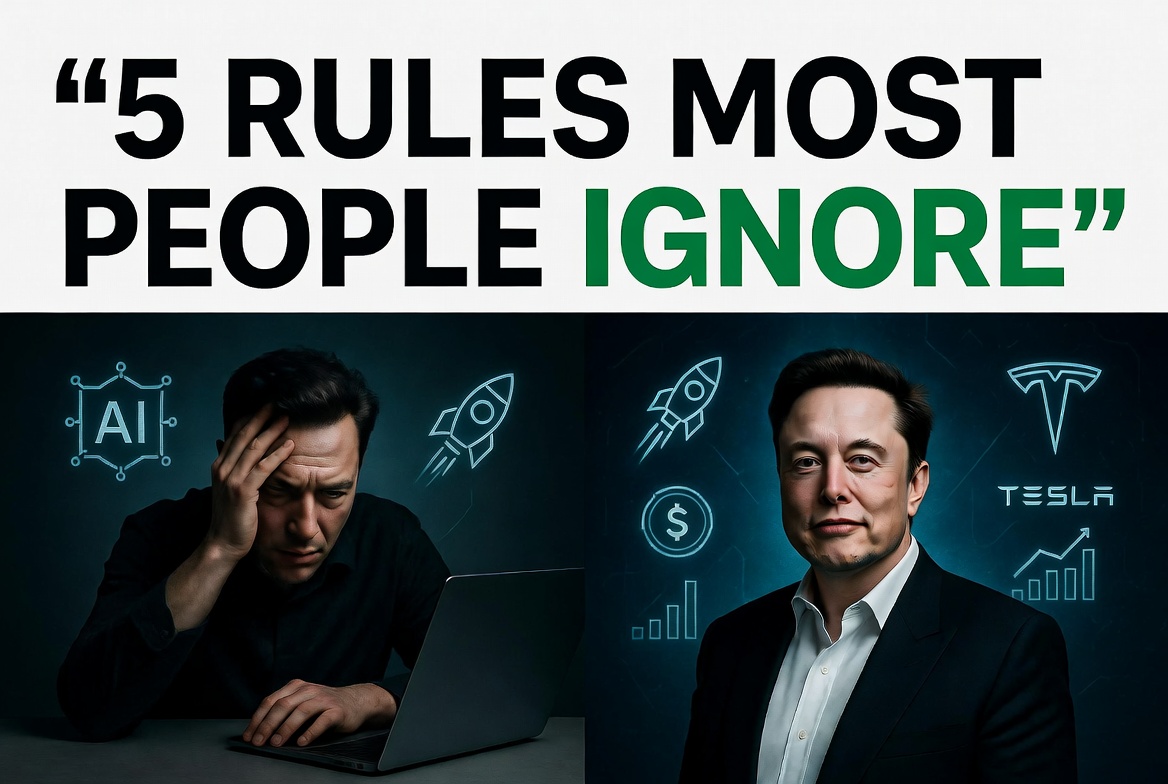
Elon Musk Rules Most Americans Ignore (This Changes Everything)Most people scroll past Elon Musk news and think — “that guy’s just lucky.” They see the headlines about elon musk net worth 2026 crossing into trillionaire territory, the rockets, the brain chips, the satellites, and they chalk it all up to privilege or timing. But here’s the uncomfortable truth: luck doesn’t build SpaceX, Tesla, and X from the ground up. Rules do. Systems do. And a mindset that most people flat-out refuse to adopt does.
Quick Summary: What Are the Elon Musk Rules Most Americans Ignore?
Born in Pretoria, South Africa — so yes, where was elon musk born is South Africa, not Silicon Valley — Musk immigrated to Canada, then the US, and became a naturalized citizen. Today, is elon musk a us citizen? Yes. And he built his empire entirely on American soil, from PayPal to Tesla to SpaceX to elon musk x (formerly Twitter). His elon msk net worth 2025 sat above $300 billion, making him the richest person on the planet by a wide margin. The rules behind that are hiding in plain sight.
- Rule 1: Think in First Principles, Not Borrowed Assumptions
- Rule 2: Work at a Pace Most People Would Call Unreasonable
- Rule 3: Put Your Money Where Your Conviction Is
- Rule 4: Build Brands That Become Movements
- Rule 5: Use Feedback Loops Relentlessly
- Rule 6: Ignore the Crowd — Then Hire the Best of It
- Rule 7: Play Infinite Games, Not Short-Term Ones
Let’s break every one of these down.
Rule #1: Think in First Principles, Not Borrowed Assumptions
Most People Rent Their Thinking — Musk Owns His
Ask anyone why something costs what it costs, and they’ll say “because that’s what it costs.” Musk asks a different question: “What does it actually cost to build this from raw materials?” That’s first principles thinking — stripping every assumption away and rebuilding logic from scratch.
It’s how elon musk build rocket engines at a fraction of what NASA was paying. SpaceX reduced the cost of launching a rocket by nearly 90% not by working harder but by thinking differently. Everyone else accepted the price of aerospace. Musk questioned the entire premise.
You don’t need to build rockets to use this. Next time you hit a business wall, ask yourself: “What am I assuming that might not actually be true?” That one question can unlock solutions everyone else walked right past.
How to Apply It
- Take your biggest current business problem and write down every assumption baked into it.
- Challenge each one: “Is this actually true, or is it just how things have always been done?”
- Rebuild your approach from the ground up with only verified facts.
For more on developing this kind of strategic thinking, read our guide on first principles thinking for entrepreneurs.
Rule #2: Work at a Pace Most People Would Call Unreasonable
The Man Slept on Factory Floors — What’s Your Excuse?
When Tesla was on the verge of collapse in 2018, Musk famously slept on the factory floor to keep production moving. At elon musk age 53 (born June 28, 1971 — so elon musk birthday is June 28), he still works 80–100 hour weeks across multiple companies simultaneously.
Now — is that sustainable for everyone? No. But the principle behind it is: intensity matters more than duration. Most people put in average hours with average focus and expect above-average results. That math doesn’t work.
You don’t need to destroy your health. But you do need to be honest about whether you’re working with real intensity or just staying busy. There’s a massive difference between 6 deeply focused hours and 10 distracted ones.
Curious about how old is elon musk and what he’d accomplished by your age? By 24 he’d already started his first company, Zip2, with his brother. By 28 he’d sold it for $307 million. Whatever age you’re at — the clock is ticking in your favor if you start now.
How to Apply It
- Audit your actual productive hours this week — not time at a desk, but genuinely focused output.
- Eliminate your three biggest time drains immediately.
- Work in deep 90-minute focus blocks. No phone. No notifications. Just output.
Check out our breakdown of deep work strategies for entrepreneurs who want to produce more in less time.
Rule #3: Put Your Money Where Your Conviction Is
He Bet Everything — Literally
After selling PayPal, Musk had around $180 million. He put $100 million into SpaceX, $70 million into Tesla, and $10 million into SolarCity. He was nearly broke by 2008. Both companies were days from bankruptcy simultaneously. He didn’t pull out. He doubled down.
People always ask how much money does elon musk have today — the answer fluctuates daily but sits in the hundreds of billions. What they don’t ask is how close he came to having nothing. That’s the part that matters.
Risk tolerance isn’t recklessness. It’s calculated conviction. Musk didn’t gamble — he built rockets and cars because he understood the physics, the market, and the mission better than anyone else in the room. When you know something deeply, betting on it isn’t crazy. It’s logical.
According to Forbes, Musk’s willingness to reinvest personal capital was a defining factor in both Tesla and SpaceX surviving their near-death moments.
How to Apply It
- Identify the one thing you know better than almost anyone else.
- Ask yourself: “Am I actually investing — time, money, energy — in proportion to my conviction?” Most people aren’t.
- Start small. Reinvest your side hustle profits back into your side hustle before you spend them.
Read our guide on calculated risk-taking in business and how to know when to go all in.
Rule #4: Build Brands That Become Movements
Tesla Spends $0 on Traditional Advertising. Think About That.
Elon musk tesla has never run a Super Bowl ad. No billboards. No celebrity endorsements. Yet it’s one of the most recognized brands on the planet. How? Because Musk made the brand inseparable from a mission — accelerating the world’s transition to sustainable energy. People don’t just buy Teslas. They join something.
The same goes for elon musk twitter — when he acquired Twitter and rebranded it to elon musk x, it generated more free press than any paid campaign could have bought. His elon musk tweets alone move markets, spark debates, and keep millions of people engaged daily.
Whether people agree with elon musk and trump or his political moves — the man understands that attention is the most valuable currency in the modern economy. And he’s mastered generating it.
Your business doesn’t need a massive ad budget. It needs a clear mission that people want to be part of. What does your brand stand for beyond the product it sells?
How to Apply It
- Write your brand mission in one sentence — not what you sell, but why it matters.
- Create content that serves your mission, not just your product.
- Build a community around your niche. Communities market themselves.
Learn how to build a mission-driven brand that generates organic attention without a massive ad spend.
Rule #5: Use Feedback Loops Relentlessly
SpaceX Rockets Explode on Purpose — That’s the Point
SpaceX blows up rockets. Intentionally. Not because they’re careless — because rapid iteration beats slow perfection every single time. Each explosion generates data. That data improves the next launch. The feedback loop is the product.
Elon musk satellites through Starlink now provide internet to over 100 countries. Elon musk internet via Starlink exists because SpaceX iterated faster than any government agency ever could. The elon musk brain chip through Neuralink is going through the same process right now — test, learn, improve, repeat.
Most entrepreneurs launch something, get one round of feedback, feel discouraged, and pivot entirely. That’s not iteration — that’s quitting in disguise. Real feedback loops mean shipping fast, measuring honestly, and improving without ego.
How to Apply It
- Ship your product or service before it feels ready. Perfection is a delay tactic.
- Build in a structured feedback mechanism — surveys, reviews, direct conversations.
- Set a monthly iteration cycle: review feedback, pick the top three improvements, ship them.
See how rapid product iteration can double your growth rate without doubling your workload.
Rule #6: Ignore the Crowd — Then Hire the Best of It
Contrarian Thinking + Elite Talent = Unstoppable
Musk ignored every expert who said reusable rockets were impossible. He ignored everyone who said electric cars couldn’t compete with gas engines. He ignored the analysts who said Twitter was overpriced at $44 billion. He forms his own views — then executes on them with world-class teams.
That combination is rare. Most people either follow the crowd entirely or go contrarian without the execution ability to back it up. Musk does both simultaneously: independent thinking at the top, elite talent deployment throughout.
Talking about elon musk vs mark zuckerberg — both are brilliant at hiring. But Musk’s companies consistently attract engineers and operators who are obsessed with the mission, not just the paycheck. That cultural intensity is a direct product of his leadership style.
For your business, this means: trust your own research and instincts, but never let ego stop you from hiring people smarter than you in specific areas.
How to Apply It
- Develop a genuine point of view on your industry — not borrowed from podcasts, but from your own research and experience.
- Hire for obsession and values alignment, not just credentials.
- Be willing to be wrong publicly. It signals intellectual honesty — and attracts great people.
Read our breakdown on how to hire your first team as a startup founder even with a limited budget.
Rule #7: Play Infinite Games, Not Short-Term Ones
He’s Not Trying to Win This Quarter — He’s Trying to Win the Century
When people ask how much is elon musk worth, they’re playing a short-term game. Musk himself has said repeatedly that money is just a tool to build the future he believes in — multi-planetary human civilization, sustainable energy, and advanced AI through his company xAI.
Think about elon musk doge — even his seemingly impulsive moves are part of a longer arc. His relationship with elon musk and grimes, his large family (people frequently ask how many kids does elon musk have — the answer is at least 12 children, including elon musk son X Æ A-12 and several others), and even his public persona all feed into a decades-long narrative he’s consciously constructing.
He’s playing chess while most entrepreneurs are playing checkers — and he started that chess game at the beginning of his career, not after he got rich.
The average American entrepreneur thinks in 90-day cycles. Musk thinks in decades. That time horizon difference alone explains most of the gap between ordinary and extraordinary outcomes.
According to Tesla’s official mission statement, the company’s entire strategy is built around a long-term transition to sustainability — not quarterly earnings. That long game is why Tesla survived years of losses to become the dominant EV brand globally.
How to Apply It
- Write a 10-year vision for your business or career — not goals, a vision. What does the world look like if you win?
- Make decisions that 10-year-future-you would applaud, even if present-you finds them uncomfortable.
- Stop optimizing only for this month’s revenue. Build systems, assets, and relationships that compound.
Explore our guide on long-term thinking in business strategy and why most entrepreneurs give up one year too early.
How to Start Applying These Elon Musk Rules — Starting This Week
You don’t need to be a tech genius or have venture capital backing. Here’s your practical week-one action plan:
- Monday: Pick one belief about your industry and challenge it with first principles. Write it out.
- Tuesday: Track your actual focused work hours for 24 hours. Be brutally honest.
- Wednesday: Identify where your conviction is highest — and whether your investment of time/money reflects that.
- Thursday: Write your brand mission in one sentence. Post it somewhere you see it daily.
- Friday: Ship something — a post, a product update, a pitch — and actively seek feedback on it.
- Weekend: Write your 10-year vision. Keep it bold. Keep it specific.
One week of intentional action won’t make you a billionaire. But it will put you on a completely different trajectory than the one you’re on right now.
For additional resources on building wealth from the ground up, check out SpaceX’s founding story — it’s a masterclass in long-term conviction over short-term comfort.
Common Mistakes People Make When Trying to Apply These Rules
Don’t Let These Kill Your Progress
Idolizing instead of analyzing. There’s a big difference between being inspired by Elon Musk and actually extracting actionable principles. Don’t put anyone on a pedestal — study their methods with a critical eye.
Applying intensity without direction. Working 80 hours on the wrong thing is worse than working 40 hours on the right thing. Rule #2 only works if Rule #1 (first principles thinking) is running underneath it.
Mistaking noise for feedback. Not all feedback is useful. Musk doesn’t optimize Tesla based on Twitter comments. He uses engineering data, customer behavior, and market signals. Know the difference between signal and noise in your own business.
Short-term thinking dressed up as strategy. Plenty of entrepreneurs write 10-year visions and then make 10-day decisions. The vision has to actually inform your choices — or it’s just a motivational exercise.
Waiting until you’re “ready.” Musk launched rockets that exploded. You can launch an imperfect product. The market will tell you what to fix. Your job is to show up and iterate.
For a full breakdown of the wealth-building traps to avoid, read our guide on the most costly entrepreneur mistakes and how to sidestep them early.
The Bottom Line: Elon Musk Didn’t Ignore These Rules — Neither Should You
Here’s the thing about elon musk that most people miss: none of his rules are secret. He’s talked about first principles in interviews, work ethic in documentaries, and long-term thinking in shareholder letters. The information is everywhere.
The gap isn’t access to the rules. It’s the willingness to actually apply them.
Most people read about elon musk net worth and feel either inspired for five minutes or quietly resentful. Neither response changes anything. What changes things is taking one rule — just one — and building it into how you operate this week. Then the next week. Then the one after that.
That’s how compound growth works. Not in one dramatic moment, but in hundreds of small, intentional decisions that stack up over time.
Musk didn’t become the world’s richest person by accident. He did it by operating on rules most people ignore. You’ve got the rules now. The next move is yours.
Ready to build smarter? Start with our complete guide to building wealth from zero — no trust fund required.
Also check out our full resource on Elon Musk’s most powerful business lessons for entrepreneurs at every stage.